Tag: Rod Serling

  • A Wondrous Magic to Christmas

    Finding redemption with the festive spirit (and Rod Serling and Peter Cushing)

    ” The Night of the Meek” (The Twilight Zone Season 2, Episode 11)
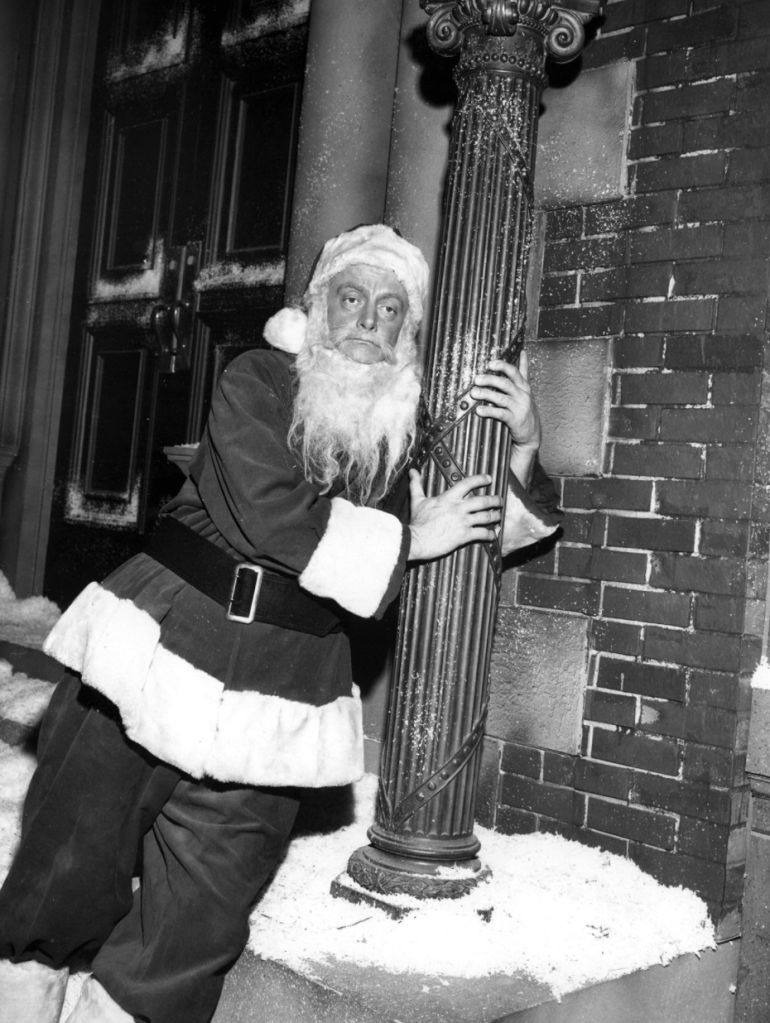
    Henry Corwin in Santa costume, looking the worse for self-inflicted wear

    The Twilight Zone is inarguably one of television’s truly great series. For an anthology show it has a remarkable hit rate. Every such series had its duds but for this show, they are few and far between. Even the weakest episodes have something to them, a line of dialogue or a moment that sparkles. For this writer, Rod Serling is one of the most gifted writers the medium has ever had, and in addition to that was a compassionate person who used his work to connect audiences with their fellow humans, to illuminate the human condition, to encourage us to be better, to do better, to try again. The Twilight Zone often traded in stinging or stirring tales of fantasy, science fiction and sometimes horror. As with many shows, it also had its Christmas-themed episodes and it is one of them, “The Night of the Meek”, covered here.
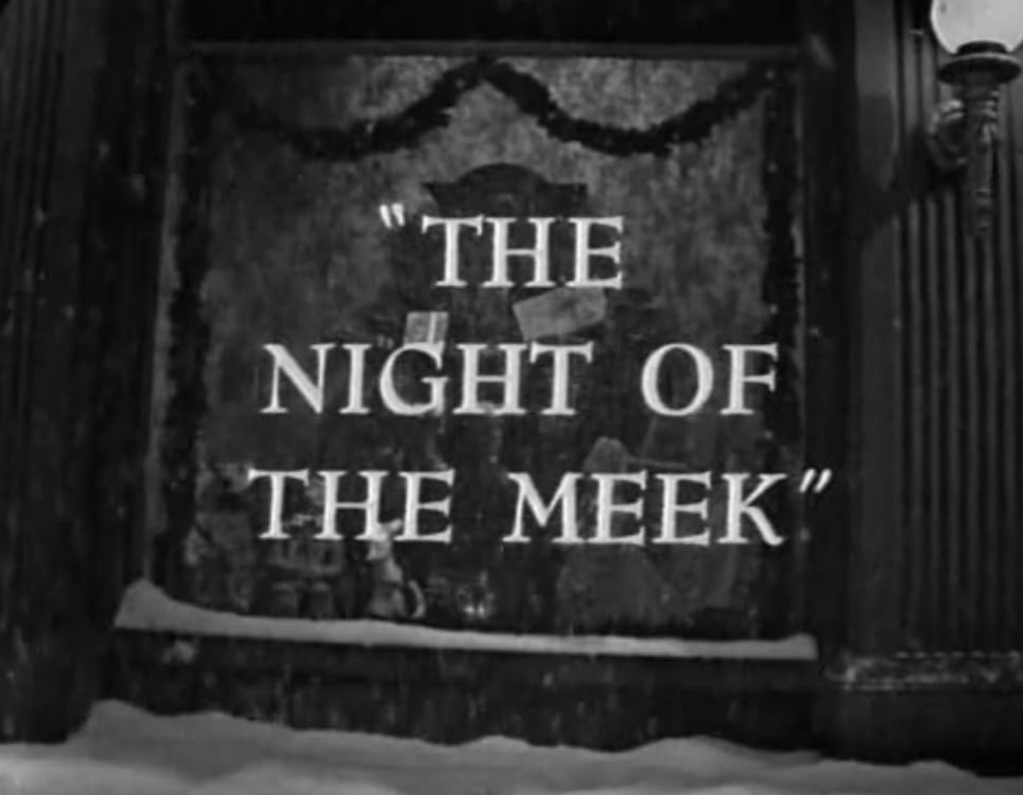
    Title card for The Night of the Meek

    The macabre in Meek is people. The set up in the episode is following department store Santa and general sad sack Henry Corwin. Corwin doesn’t have much to look forward to other than his next drink. He lives in a ‘dirty rooming house’ and his world is one of hungry children and other ‘shabby’ people just like him. Corwin lives for his Santa routine but the shine has gone out of it.  His suit is old and worn and when he shows up too late and drunk with it for his gig, it’s over – he’s fired and ordered out of the store. Despite all of his woes, Corwin muses if he had one wish, it would be for the meek to actually see some rewards. When Corwin can’t even get back into the bar he frequents, he stumbles down an alleyway where the sound of sleigh bells are heard. 

    Corwin in his Santa costume in the department store, being berated by his boss

    In the alley, Corwin comes across a sack that he quickly discovers appears to have magical properties. It produces a seemingly never-ending stream of gifts. Whatever someone asks for, they get. His dream coming true, Corwin starts handing out gifts to the poor kids and down and out men nearby. The episode continues with this mix of melancholic reality and fantastical whimsy towards its hopeful conclusion.
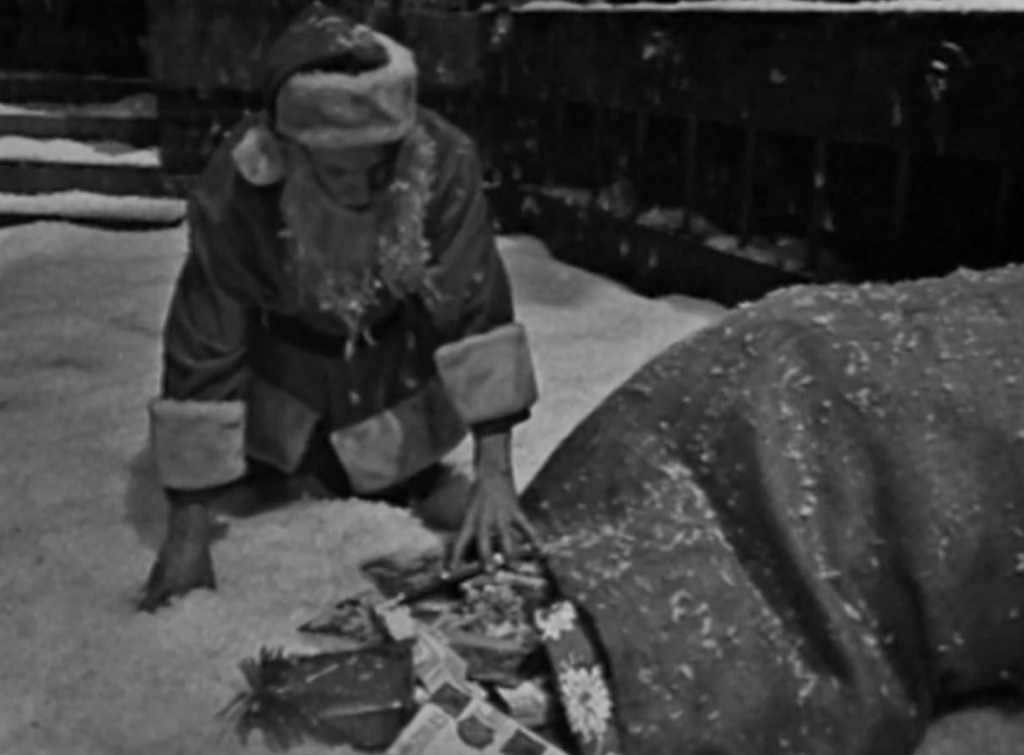
    Corwin discovering a sack full of presents in a snowy alley

    In the episode, people are the worst. Everyone expects and looks for the worst in Corwin because that’s the type of guy they think he is. It’s the type of guy Corwin has come to think he is too, and it’s pretty obvious his idealism and hope is frayed and being drowned in a puddle of cheap booze.  Corwin is us – we want to believe in the best of people, but people make it pretty damn hard. Now, Serling had around 25 minutes an episode to do set-up, delivery and conclusion of his stories and so subtlety was not always the prime concern. The characters, Corwin included, are mostly broad sketches, with people like the shop manager Dundee being not much more than functional cliché. They’re ciphers for the point Serling is making about what Christmas can represent. 
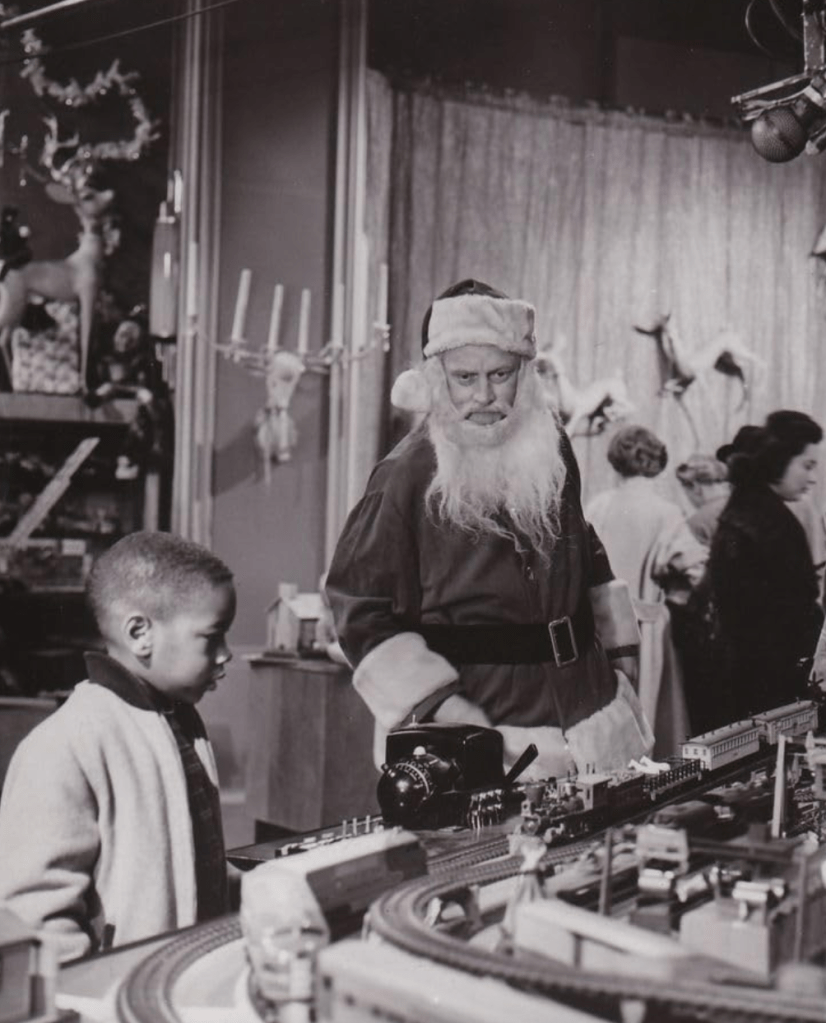
    Corwin watching a young child enjoying a train track set up

    It can, if we let it, represent good will to each other, hope for the future and the unity such celebrations can bring.  If we let go of the hardened cynicism and the weariness, if we let such notions in, even if it’s only for one night we can believe that we’re more good than bad, that’s there something worth saving in us, that we can believe in magic. For many, that’s a hard thing to do in a world, in a world that tells us there’s no magic left, only bleakness and decline. In the time The Twilight Zone was first airing it was only 15 years or so since the end of WW2. It was before Vietnam, race riots, Watergate and innumerable other events conspired to convince even the most indefatigable optimist that we’re on a downward spiral as a species. 

    That’s not to say things were better then as many things were emphatically not. But it’s for this reason that we should arguably let a little magic into our lives. Believing in Santa Claus might have ended a long time ago for most of us but believing in each other, or that there is some goodness out there, is something we all need these days. And if anyone can convince you to believe in your bones that humans are redeemable, it would be Serling.

    Rod Serling in coat covered in totally real snow, speaking to camera

    As Rod himself puts it in the closing narration “There’s a wondrous magic to Christmas”, so here’s to Henry Corwin and here’s to The Twilight Zone and a momentary respite, a sliver of the brightest light in the darkness of winter.

    Cash on Demand

    Cash on Demand title card

    How does Cash on Demand (1961, dir. Quentin Lawrence) evoke a similar joy? Well, it’s not just the ideal Christmas movie but a reminder that, for those of us who might despair at humanity’s worst instincts more days than not, change is possible. Based on the play, it’s the tale of bank manager Harry Fordyce (Peter Cushing), a fussily fastidious man who rules over his branch not so much with a clenched fist but a puckered sphincter. The opening scenes set up the tight-knit team of staff in the bank as they await Fordyce’s arrival. When he does appear their anxious joviality is curtailed and it’s down to the business of money.

    Fordyce looking for flaws in the polished plaque outside the bank

    Not long after this, André Morell pulls up at the bank, his character Colonel Gore-Hepburn supposedly an insurance inspector but in fact a bank robber. Using threats and coercion, Gore-Hepburn forces the unravelling Fordyce to partake in robbing his own bank. Without giving anything away, the plot twists, new wrinkles are added and tension is ratcheted up. Throughout all this Cushing is wonderfully good, ensuring Fordyce is no cliche and imbuing him with humanity throughout. Morell matches him throughout as the smooth, assured, and ruthless bank robber. 
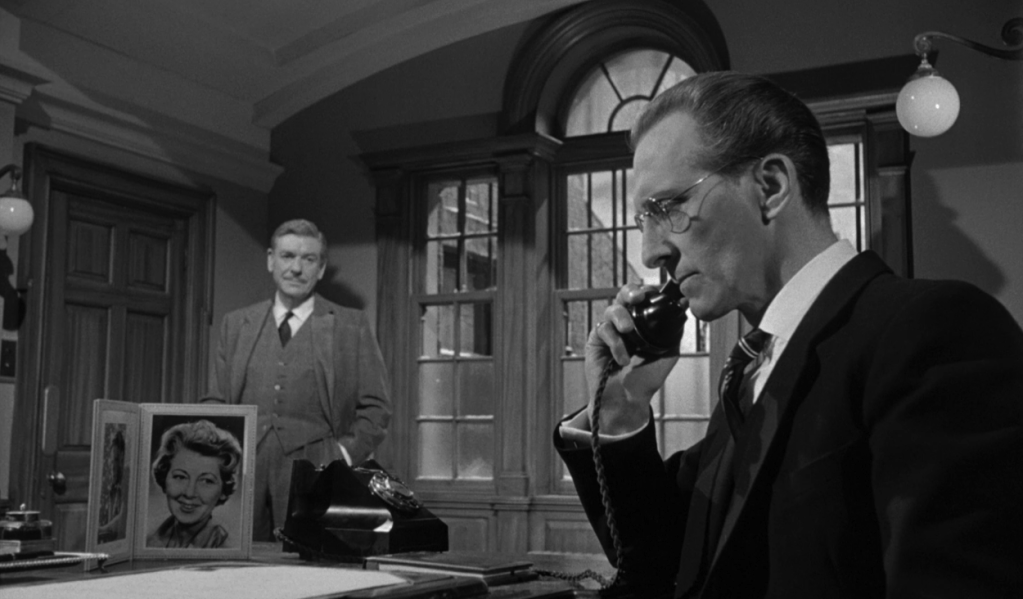
    Fordyce on the phone in his office as Gore-Hepburn looks on, his plan coming together

    Cash on Demand is a twist on A Christmas Carol. Fordyce might not be the wicked man Scrooge was, but he has forgotten what makes a person. He’s not mean to his staff so much as dismissive of their personhood and feelings, only focussing on the bank and profit. We know early on he has a child and wife he feels affection for, but that’s as far as human warmth goes for him. As Gore-Hepburn’s scheme to steal thousands of pounds unwinds, and Fordyce is forced to become part of the heist, he must confront what he has become, what is really important to him, and reconnect with the world he lives in. It’s an uplifting, very human film about hope and change and our ability for both that is just as needed in these modern times.
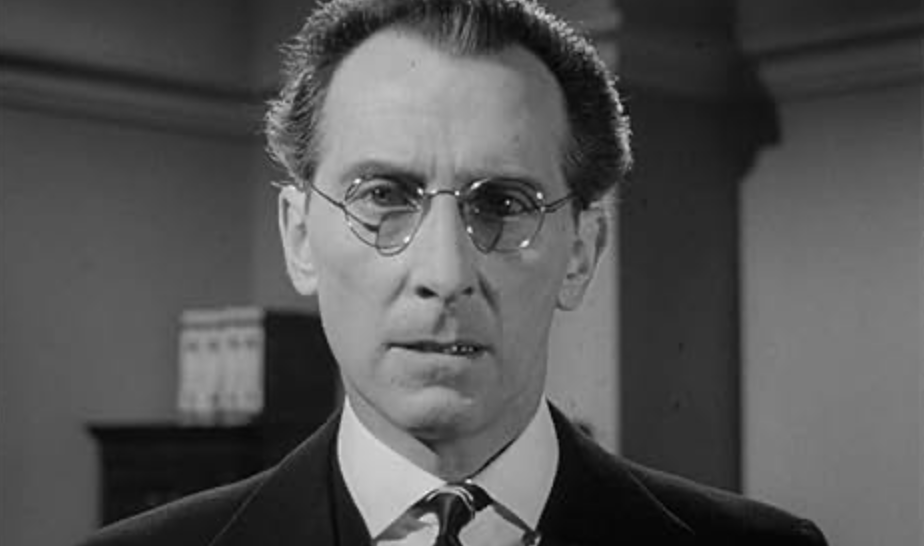
    Fordyce looking directly to camera, a concerned and unsettled look on his face

    The Christmas trappings aren’t window dressing either. The time of year the story is set is intrinsic to the mood and atmosphere of the piece and to Fordyce’s journey. Of course, it’s a fine film that could be shown at any time of year. But what it says about us as people is a classic Christmas message. If you want a beautifully judged thriller, full of quotable dialogue, with one great scene after another, excellent performances, and something to say about what it means to be alive, this is it.
  • Rod Serling doesn’t want you to be a piece of shit, and neither do I

    Contemplating the panic of the inevitable in ‘The Cemetery’ and the choices we make

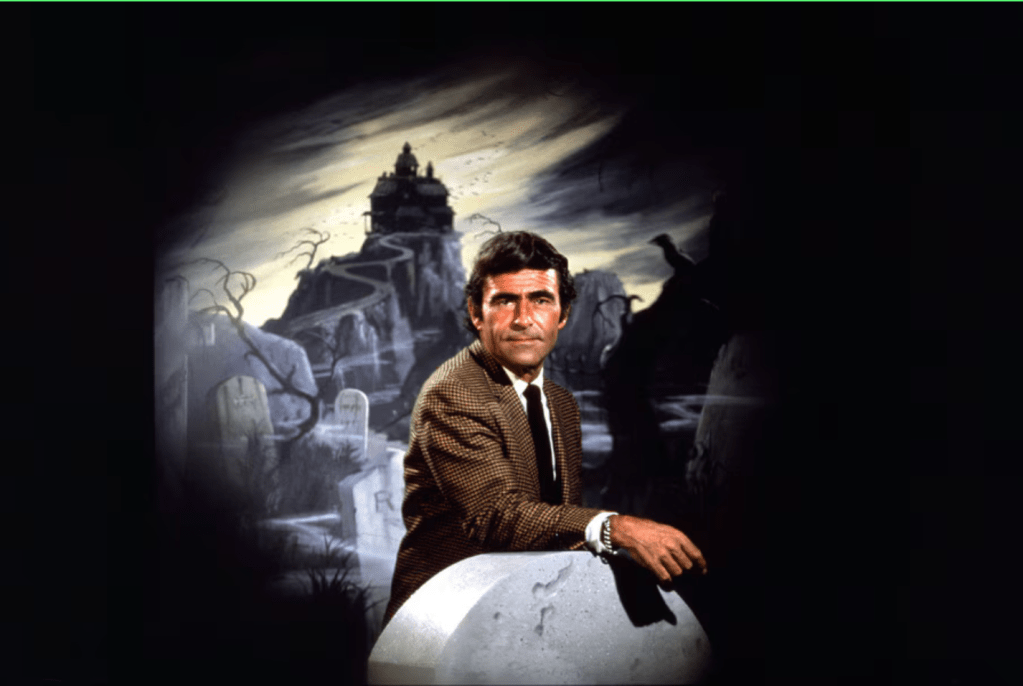
    Rod Serling posing in a graveyard setting for a promotional photo

    For several reasons, I’ve been thinking more in recent years about who I understand myself to be and what legacy I want to leave in my wake. Legacy might sound overly grand, but that’s really what it is to be thought of and remembered and talked about, whether it’s by millions or by whatever nucleus of immediate people you hold to be family. A worldwide pandemic will get you to thinking about the impact we all leave on each other, and that’s not even the sum total of an at times challenging, rewarding and enlightening few years that have followed to process. Largely for me it’s about the impact of leaving the people and places you find along the way better than you found them, or at least not worse for your presence. But life makes that hard. Communicating with each other with kindness and empathy and consistency is a journey that doesn’t end. Trying to be good to the planet that hosts us while just a handful of companies continue to be the biggest polluters in the world provokes wild cognitive dissonance. Capitalism swirling the drain and dragging us with it, bloody-knuckled and exhausted, into the slop. Social media a distracting feedback loop where we play out status games and performative emoting while the literal and figurative world around us burns. The worst people clinging ruthlessly to positions of power and scapegoating the most vulnerable as cause of the world’s ills. It is easy to lose focus. 

    What has this got to do with Roddy McDowall and the Night Gallery pilot film (NBC, 1969) you may ask? Well, firstly Rod Serling and his writing has been one of the primary influences in my life on my own personal philosophy about how I treat people and how my own personal code developed, and I come back to his work regularly for course correction as much as entertainment. And in ‘The Cemetery’ and McDowall’s phenomenal performance we have humanity in crisis in microcosm, in all its sadness and rage and selfishness and dread and pathetic hope. Just as much as any episode of The Twilight Zone (CBS, 1959-1964), this play provokes in me considerations of consequence and personal choice. A warning in a world gone wrong, embodied here by McDowall’s performance and Serling’s writing. 

    Ten years after the launch of The Twilight Zone, Rod Serling was ready to revisit anthology television. In the intervening years since his beloved fantasy show had ended, Serling had kept busy with a variety of different projects, even though he was no longer the celebrated angry young man of the golden age of television. These projects ranged from a modern television movie adaptation of Charles Dickens’ A Christmas Carol (1843) reformed as a nightmare of nuclear Armageddon and a plea for cooperation between nations before mutually assured destruction, to The Loner (CBS, 1965-1966), a contemplative Western set in a this-time only figuratively haunted post-civil war America, and co-writing The Planet of the Apes (USA, Franklin J. Schaffner, 1968) amongst other films. For his new television project, this time however, Serling would move beyond fantasy and science fiction and go deep into the dark waters of horror.

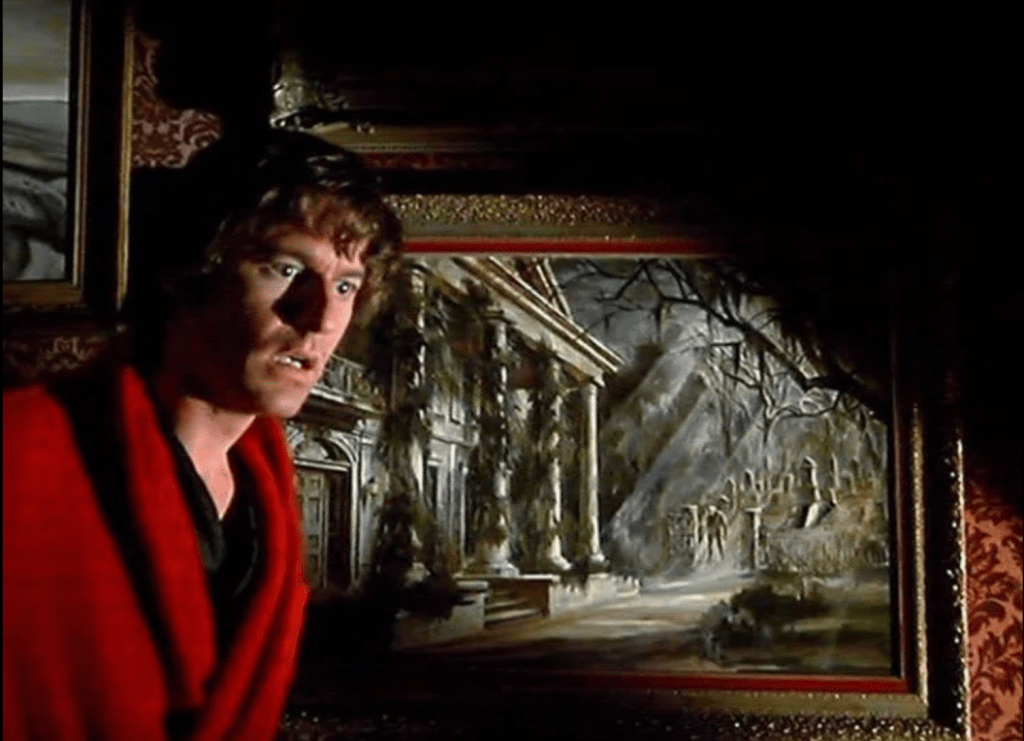
    The painting of the cemetery used in the segment

    Night Gallery premiered as a television movie on November 8th, 1969. It took the form of three separate stories, linked by Serling’s narration. He presented these tales from the titular dimly lit gallery, offering us a trio of stories that all suggest not an indifferent universe, but instead one where the immoral might be able to run from their wickedness, but not, eventually, from consequences. And it’s the first of these plays we are considering today, ‘The Cemetery’, as well as the delicate and bruising performance at its centre from Roddy McDowall. Directed by Boris Sagal, it is thirty minutes of television that distills everything that makes Serling such a great writer: emotionally literate, atmospheric, wittily loquacious and unyieldingly moral. Interestingly, the British-born and raised McDowall plays his role with a lyrical Southern-tinged accent that will just as frequently tip into British pronunciation. Similarly, Serling’s tale could just as easily be set in a country house at the edge of a small English village and nothing would need to be changed to accommodate this meeting of a tradition of Southern USA and British gothic, where the older ghosts of the past, both real and imagined, leave their graves to haunt us. It could be set here, there, or anywhere.

    Introducing the segment, Serling begins: “Good evening, and welcome to a private showing of three paintings, displayed here for the first time. Each is a collector’s item in its own way—not because of any special artistic quality, but because each captures on a canvas, suspends in time and space, a frozen moment of a nightmare. Our initial offering: a small gothic item in blacks and grays, a piece of the past known as the family crypt. This one we call, simply, “The Cemetery.” Offered to you now, six feet of earth and all that it contains. Ladies and gentlemen, this is the Night Gallery…”

    William Hendricks is old and in poor health. A series of strokes have left him largely incapacitated and housebound in the family mansion. He is attended to only by his loyal butler Osmond Portifoy, with the family burial plot the view from his window and the last thing he painted. Hendricks is wealthy and had only a sister to leave his money to, or so he thought. But with his sister dead, the inheritance will now pass to her son, Jeremy, a thoroughly disreputable man. Jeremy has moved into the home and is impatiently waiting for his uncle to die, so much so that he takes matters into his own hands to make sure William relocates to his place in the cemetery sooner rather than later. After this, Portifoy learns that a miserable stipend of $80 a month is his reward for decades of faithful service. And so, it seems, Jeremy finally has the means to support the lifestyle he is accustomed to. But then Jeremy notices that painting of the house and graves hanging at the bottom of the staircase keeps changing and suggesting his uncle is not at all at rest. 

    What follows is a beautifully paced and executed Gothic tale of vengeance that for me is some of Serling’s finest writing. One of my favourite themes in his work is that of a moral universe and our choices within it. The idea that our reality is not passive, that we can make better choices but also that there are consequences for our cruelty, selfishness and inaction. Serling was frequently concerned with equality, the impact of racism and, as his wife Carol once explained, the ‘ultimate obscenity of not caring’. In The Twilight Zone, this could be a positive exploration, if we take for example the compassion and sacrifice of Lew Bookman or the universe indulging the sentimentality of Henry Corwin. But in Night Gallery it was frequently the other side of this coin. That moral universe is unrelenting in ‘Escape Route’ (the third segment in the pilot film), ‘Lone Survivor’, ‘The Doll’ or perhaps most memorably in ‘The Caterpillar’. In all of these, bad people do bad things and, perhaps not immediately but certainly inevitably, the universe revisits this on them manyfold. Serling was always a champion of the best in humanity and what we could achieve, alone and most importantly together, and believed in the next generation and their capacity to do and be better. But he was also acutely aware of our frailties and disappointments as a species, from his experiences as a far-too-young man at war, to his own personal failings, and to the impacts of racism and isolationism in the decade that birthed Night Gallery. Perhaps this is why Night Gallery largely trades in the hope and optimism found in The Twilight Zone for more of the cosmic justice seen in that show’s ‘Deaths-Head Revisited’. 

    Roddy McDowall stood next to the painting looking unsettled. In this version of the painting, a grave can be seen open, a figure lurching towards the house

    Despite this, ‘The Cemetery’ never stoops to being cruel. Enraged perhaps, and unforgiving, but not cruel. Instead, it is human and sad, much of this found in Roddy McDowall’s performance. Jeremy at first is cruel as he taunts his uncle and brings about the old man’s death. An unremarkable and embittered would-be conman, Jeremy thinks himself destined for a life of luxury he possesses neither the means nor the character for. And in his uncle, he has found the chance to fulfil this destiny. He revels in verbose cruelty, not just to his uncle but also to Portifoy, whose name he allows to roll regularly from his tongue with contempt, for the man and for the role he plays in Hendrick’s life. There’s disgust here at a man who could be a servant but also envy. After all, Jeremy has never succeeded at anything, let alone three decades at one thing. After his uncle dies and is buried, Jeremy wastes no time in having the will executed and becoming master of the house. All through this however, McDowall uses flashes of expression or a sadness in his eyes to give Jeremy inner life. There’s part of him behind the facade that is perhaps regretful, or even himself disgusted momentarily by the brutality he is capable of. But he overrides this, pushes it down, makes his choice. 

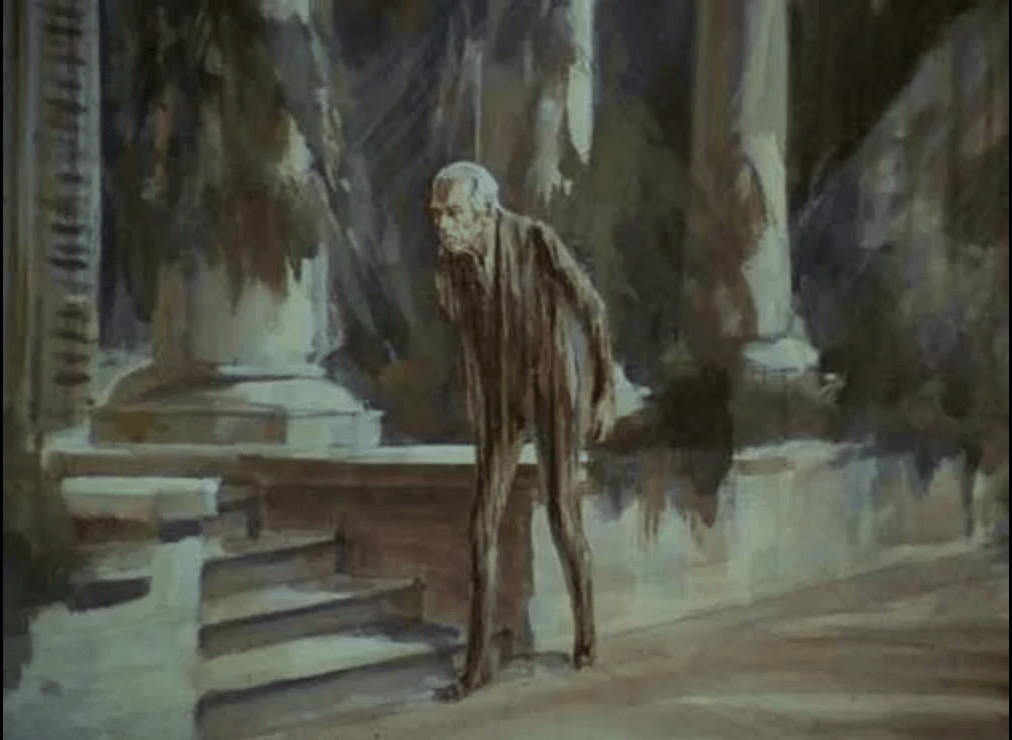
    It is soon after his uncle has died that Jeremy notices that final painting he did of the house and cemetery has changed. Something new has been added. William’s freshly dug grave has appeared on it. Jeremy asks Portifoy but Osmond says he can see nothing different. It is the beginning of the end for Jeremy. As the painting continues to alter, different each time he sees it, Jeremy has two frightening conclusions to draw. The first is unthinkable, that his uncle is not at rest and is making his way from the grave to the house to exact revenge. The second is that he is losing his mind. As he diminishes from the swaggering, arrogant swine at the segment’s opening towards an imitation of his deathly ill uncle, abandoning the fancy shirts and sharp jackets and taking on William’s wardrobe of dressing gown and blanket, McDowall invites us into Jeremy’s confusion, where both he and us can believe both at once. Pushing Portifoy too far, the butler resigns and goes to stay at a hotel in town. It is now that Jeremy is alone in the house with no one to turn to. Devolving into panic and rage and overwhelmed by fear, Jeremy has dropped all bravado, clinging to the hope Portifoy will save him. It’s a name he no longer says with contempt, but instead with desperation. 

    Jeremy’s supposedly dead uncle come to ‘life’ again in the painting

    There are many elements that for me make up why ‘The Cemetery’ is so successful at what it sets out to achieve: Serling’s words, Sagal’s assured and controlled direction, the set design and presentation, the supporting performances, the stirring and oppressive Billy Goldenberg score that mixes traditional instrumentation with atonal electronic noise. But at its core and what brings Serling’s writing to life is the complicated, human villainy in Roddy McDowall’s performance. At the start of this journey, Jeremy repulses us. At the end of it, we still despise him but pity him too and perhaps recognise ourselves more. Night Gallery may have traded hope and optimism for the finality of cosmic justice, but particularly in Serling’s work for the series, it doesn’t lose his focus on humanity. If The Twilight Zone could often be a call to arms to be better before the worst happens, Night Gallery is a warning that to be better is a journey of choice that never ends, particularly – especially – if the worst is happening now. In McDowall’s panic, fear and anger as seemingly unrelenting consequence approaches, and in that final coda sting in this tale, that warning is clear to me: it is too late for Jeremy and William and Portifoy, but not too late for us. 

    And so, I think about ‘The Cemetery’ and how art like it influences our real lives. I think about legacy and the imprints we leave on each other both while we’re here and when we’re gone. Let’s not be Jeremy, or Portifoy or Hendricks. Let’s be better. Rod Serling thought we could be, and McDowall shows us ourselves if we don’t at least try.